What is Olbers’ paradox?
Why is the night sky dark despite so many stars? Olbers’ paradox asks what we would see in an infinite, eternal, static universe with stars distributed uniformly. Every line of sight should eventually meet a stellar surface, making the entire sky bright. The dark gaps challenge those assumptions, which do not describe our actual universe. [NASA explains Olbers’ paradox](https://starchild.gsfc.nasa.gov/docs/StarChild/questions/question52.html).
Why is the night sky dark despite billions of stars?
- Finite age: the universe is approximately 13.8 billion years old, and stars formed later. Starlight has not been shining throughout an endless past. This limited history is central to resolving the paradox. [NASA on the universe’s age](https://science.nasa.gov/exoplanets/what-is-the-universe/).
- Expansion and redshift: expanding space stretches light to longer wavelengths, reducing each photon’s energy. Visible light from sufficiently distant sources can shift into infrared, beyond human vision. Expansion therefore further reduces the visible glow. [NASA on cosmological redshift](https://science.nasa.gov/mission/hubble/science/science-behind-the-discoveries/hubble-cosmological-redshift/).
- Light still out of reach: light travels at a finite speed, so light from sources too far away has not had time to reach us. This follows from the universe’s finite age; it is not a separate, unrelated cause. [NASA on distant starlight](https://heasarc.gsfc.nasa.gov/docs/objects/heapow/archive/large_scale_structure/xmm_lockman_hole.html).
Rocco and Leo
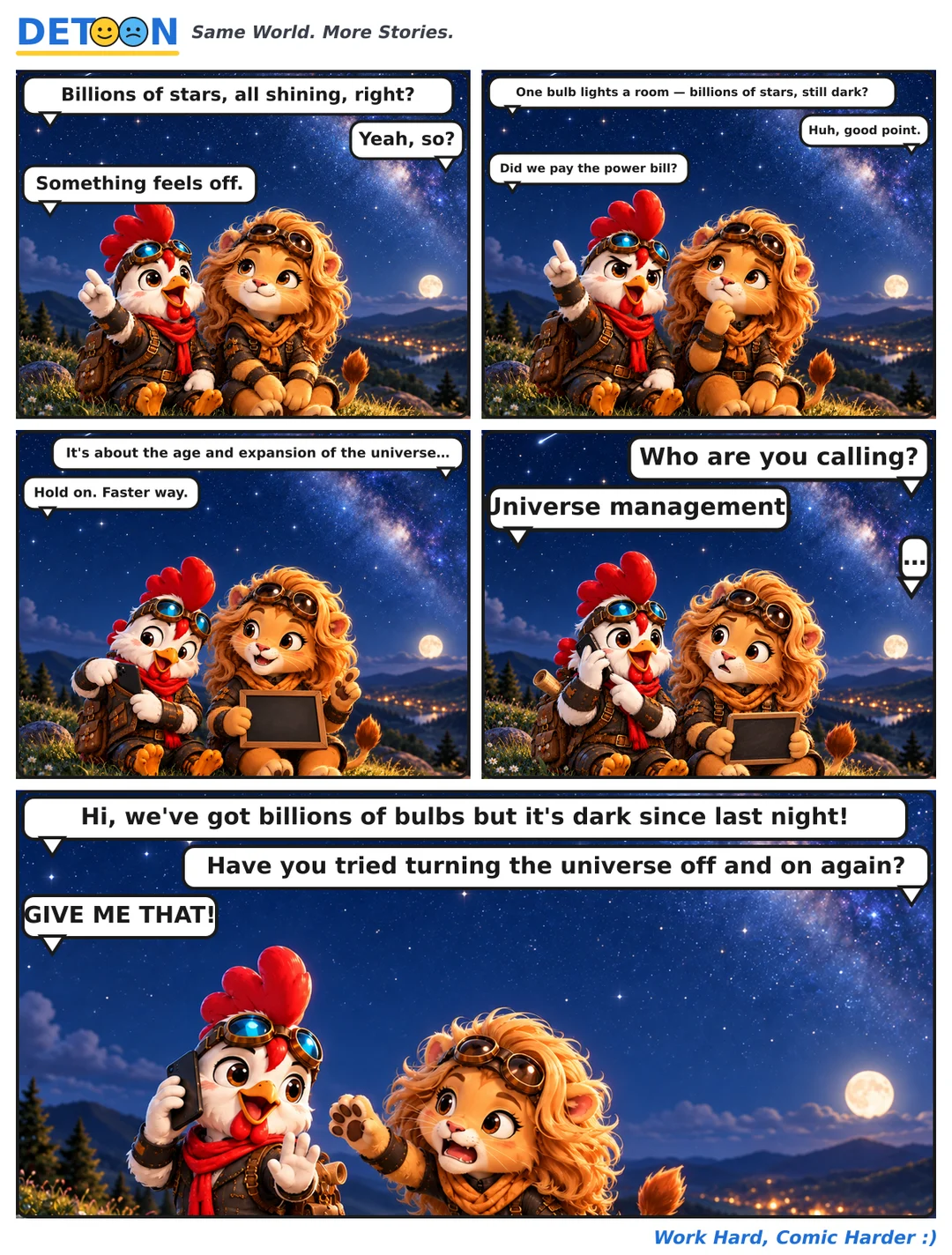
Stargazing with Rocco and Leo in this DETOON comic invites a playful thought: surely all those stars should count as ceiling lights? The universe has other arrangements. The night sky is dark not simply because there are too few stars, but because cosmic history is finite and expansion further dims the light.
Frequently asked questions
- Is distance alone enough to explain the darkness? No. In the idealized Olbers model, more distant shells contain more stars, offsetting their individual faintness.
- Does a finite age mean the universe has an edge? No. A limit on cosmic history does not establish a boundary to all of space.
- Does redshift make light disappear? No. Its wavelength increases; suitable instruments may detect light our eyes cannot see.
- Are dark patches completely free of light? No. Darkness to human eyes does not mean an absence of radiation.