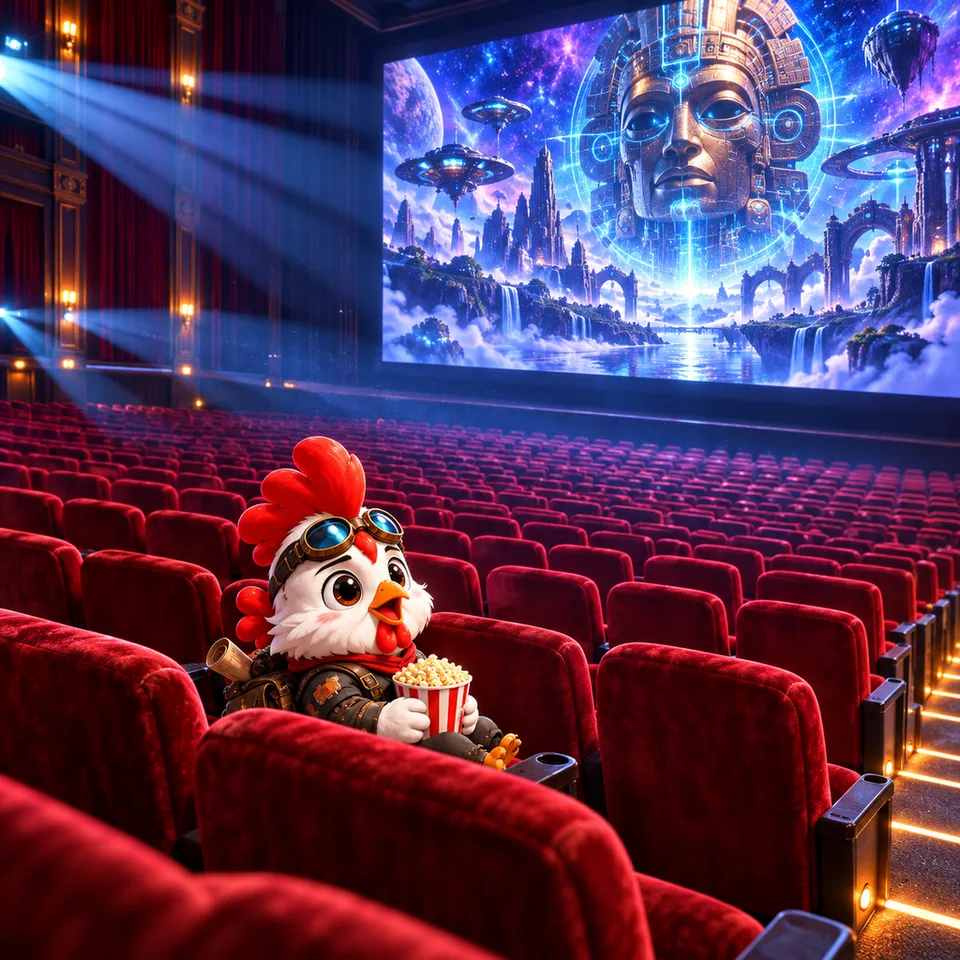
Promoted as a technological milestone for cinema, the sci-fi animated film 'Sanxingdui: Future Past' (三星堆:未来往事) had a rather quiet opening. After four days in Chinese theaters, the fully AI-produced work took only about 1.23 million yuan, and at one point drew almost no audience into the halls.
Four days in theaters, just over a million yuan
On October 23, 2026, 'Sanxingdui: Future Past' was released in Chinese cinemas. It is billed as the country's first feature-length animated film made with a full AI production process and granted a 'dragon seal' — the license for commercial theatrical release. The film runs 100 minutes, blending science fiction with the ancient Sanxingdui civilization.
However, its box-office result did not match the attention on the technology. According to Maoyan Professional data cited by Chinese media, as of the evening of October 26 the film had taken about 1.235 million yuan — roughly US$172,000 at a reference rate of 7.15 CNY/USD.
Notably, a snapshot on October 26 showed seat occupancy of just about 0.2%, equal to an average of roughly 0.3 viewers per screening. That is a figure from one specific moment, not proof that every screening had only one person; but it reflects very low interest.
From tech hype to box-office reality
Before release, the film drew strong interest from the tech, film and investment worlds. The novelty lies in the process: instead of filming with real actors, the team used AI to create characters, settings and most of the visuals. It was developed by Bona Film Group over more than two years, with Shengshu Technology's Vidu as the core technology partner.
The production cost was described at more than 10 million yuan — significantly lower than a comparable VFX project made traditionally. But a lower cost does not mean audiences will automatically buy tickets.
One common misconception: 'AI makes the film' does not mean pressing one button for a whole movie. Bona's CEO, Jiang Defu, said this was an industrial process with nearly 100 people, fixing it almost frame by frame — not 'generate once and done'.
Audiences not yet convinced?
Some Chinese viewers said the film's visuals and music had notable moments, but character movement, facial expressions and narrative flow were not convincing. Some felt characters sometimes changed appearance inconsistently, lip-sync was off, and transitions felt disjointed. These are responses from a segment of viewers, not a verdict representing the whole audience.
Film experts also pointed to a core challenge: viewers may be curious about new technology, but when they pay for a ticket, they still expect a compelling story and a complete cinematic experience. An AI film can grab attention on social media, but holding an audience for 100 minutes in a theater takes more than technology.
The stock hit the limit up, then reversed
The gap between expectation and result also showed in the stock market. Before release, Bona Film Group's shares repeatedly hit the daily limit up as investors eyed the promise of AI in film — at one stretch, three limit-ups in six sessions.
But the stock then reversed: the company had to disclose unusual price movements and warn that box-office revenue was uncertain; according to Chinese media, from October 13 to 26, Bona shares fell more than 27% cumulatively, including a limit-down session just as the weak revenue news drew attention. The market appears to be re-pricing the gap between technological potential and real revenue.
Still, one film's result is not enough to conclude that the whole AI-film direction will fail. Bona itself is not backing off: it has announced its next AI film, expected in 2027.
AI can make a film, but not necessarily a good one
The weak opening of 'Sanxingdui: Future Past' raises a big question for the wave of AI content. Generative technology is helping producers cut modeling time, test settings and create shots that once took heavy manpower — especially appealing to small studios, independent creators and budget-limited projects.
However, producing thousands of beautiful images does not automatically create a good story. Audiences still need memorable characters, emotion, sensible pacing and a reason to watch to the end. For theatrical films the bar is even higher, because viewers must spend time traveling, buying tickets and sitting in the hall.
Frequently asked questions
- What is 'Sanxingdui: Future Past'? — A 100-minute sci-fi animated film by Bona Film Group, billed as China's first AI-made feature licensed for commercial theatrical release, launched on October 23, 2026.
- How much did it make? — About 1.23 million yuan (nearly US$172,000) in four days, as of the evening of October 26 per Maoyan data.
- Did every screening really have one viewer? — Not quite. The roughly 0.3 viewers per screening and 0.2% occupancy are a snapshot from October 26, not a four-day average.
- Why did it flop? — The 'AI' label does not by itself drive ticket sales; viewers found the story and character motion unconvincing; the film also lacked stars and marketing.
- Is AI filmmaking one-button? — No. Bona's CEO said it went through an industrial process with nearly 100 people, fixing it almost frame by frame.
The real lesson
The lesson from China's first AI feature in theaters may not be 'AI cannot make films', but 'audiences do not buy tickets just because a film was made with AI'. In the future, technology may keep changing how films are produced. But the ability to tell a story and move viewers will still decide whether a work is embraced.