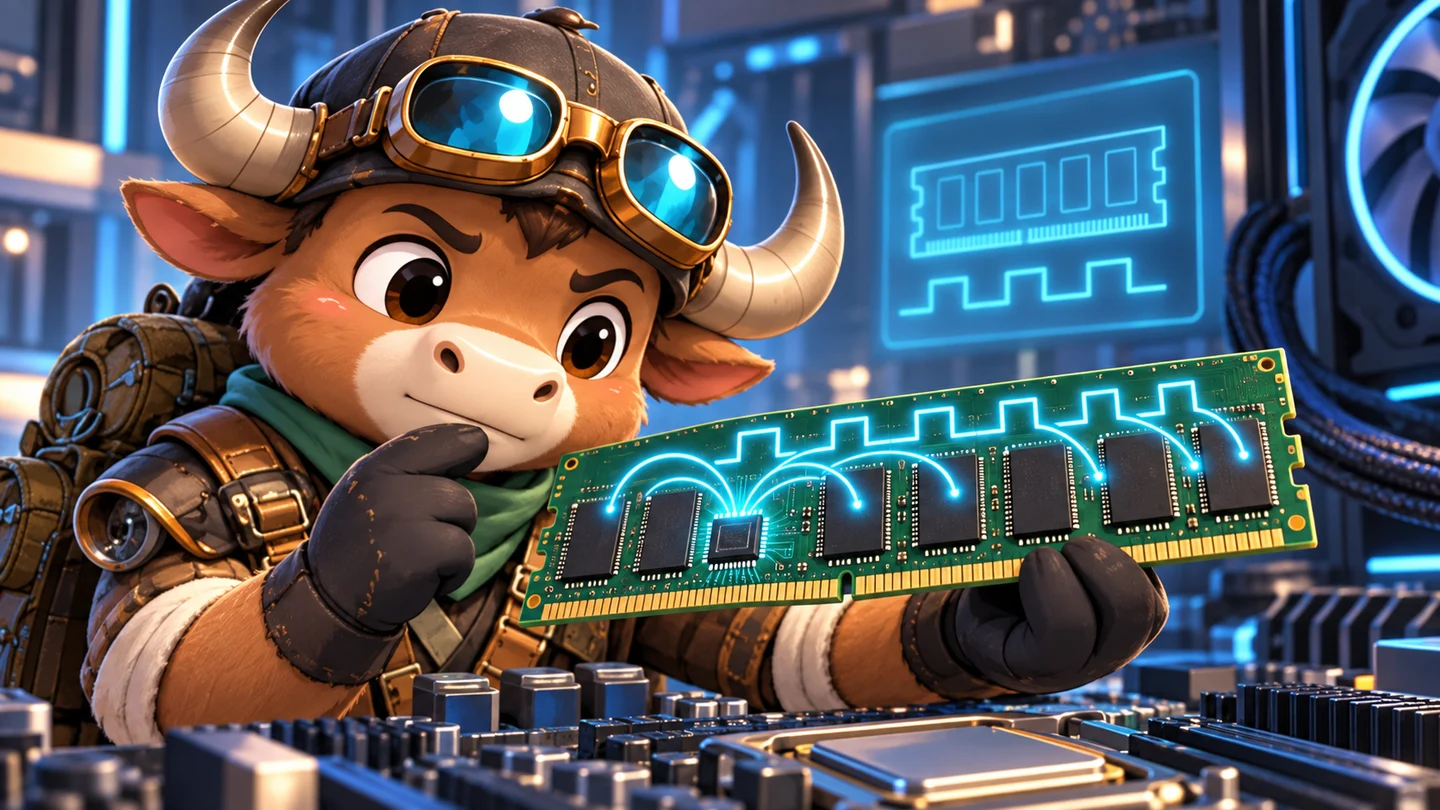
Montage Technology says its Client Clock Driver (CKD) chip supporting DDR5 up to 9200 MT/s has been introduced and offered as samples (part M88DR5CK01P). It's a component used on next-gen CUDIMM, CSODIMM (and CAMM) memory modules, improving clock-signal integrity as DDR5 keeps climbing to higher speeds.
For accuracy: this is a new sample/product step, following the DDR5 7200 MT/s CKD that Montage put into mass production back in 2024 — not a 9200 MT/s part already mass-produced. The original announcement dates to around late 2025; DETOON revisits it as a lasting technology explainer.
What is a CKD and why does DDR5 need it?
When we look at RAM we usually care about three things: capacity → speed → latency. But for DDR5 to run stably at ever-higher speeds, the electrical signal between the CPU and the memory chips becomes a harder problem. That's where the CKD — Client Clock Driver — comes in.
The CKD receives the clock signal from the memory controller, then buffers and redistributes it to the DRAM on the module. Simply put: the CPU sends the 'beat' to the RAM, and the CKD helps that beat reach the memory chips more cleanly and stably. JEDEC added the CKD to new DDR5 module standards like CUDIMM (desktop) and CSODIMM (laptops/compact devices) to support higher data rates.
From DDR5-6400 to DDR5-9200
Per Montage, the new CKD supports data rates up to 9,200 MT/s — a notable jump over mainstream DDR5 in earlier generations. Note that MT/s isn't quite the same as MHz. DDR stands for Double Data Rate: data can transfer on both edges of a clock cycle, so DDR5 speed is usually expressed in MT/s (mega transfers per second).
DDR5-9200 therefore means up to about 9.2 billion data transfers per second per data pin — NOT a physical clock running at 9.2 GHz.
Why not wire the CPU straight to the RAM like before?
At lower speeds, distributing the clock directly is fairly manageable. But the higher the speed, the more noise, jitter, signal loss and shrinking timing margins matter. The CKD acts as an intermediate layer: instead of the clock signal directly carrying the load of many DRAM chips, the CKD takes the input and produces suitable outputs for each group of DRAM. The result is a module better able to maintain signal integrity at high speed. Montage says the chip can also be software-configured to disable unused output channels, cutting dynamic power — useful for battery life and thermals in client devices.
How does CUDIMM differ from regular UDIMM?
UDIMM is the common desktop RAM of many years. A CUDIMM is basically still a client-PC DIMM, but the C signals the presence of a Clock Driver. Think of it this way: UDIMM is traditional desktop RAM; CUDIMM is DDR5 desktop RAM with an added CKD to support high-speed clocking. Similarly, SODIMM (laptops) has a CSODIMM variant (SODIMM with a CKD). JEDEC published the CUDIMM and CSODIMM standards for client systems needing higher DDR5 speeds.
Who is Montage Technology?
Montage Technology is a fabless semiconductor company focused on interconnect and memory solutions, with a notable presence in the DDR ecosystem. It develops various memory-interface chips such as the DDR5 CKD, Registering Clock Driver (RCD), Data Buffer, Serial Presence Detect and other module components. Bringing a DDR5-9200 CKD to samples is therefore well within its core area.
Does DDR5-9200 mean every PC can run 9200 MT/s?
No. This is very important. A CKD supporting 9200 MT/s does NOT mean buying a CUDIMM with this chip guarantees your machine runs DDR5-9200. Real memory speed also depends on the CPU and memory controller, motherboard, BIOS, DRAM modules, number of DIMMs, timings, voltage and what the platform supports. The CKD solves an important part of the signal problem, but it's not the only thing that determines final RAM speed.
Is a CKD a memory chip?
Also no. A CKD doesn't store data like DRAM; its role is closer to coordinating and regenerating the clock signal for the memory chips. So a CUDIMM stick can contain DRAM (where data lives) and a CKD (which supports the clock signal). That's why a relatively small chip becomes an important component as DDR5 keeps speeding up.
Why does this matter?
DDR5 is reaching a stage where going faster no longer depends on the DRAM alone. The whole system around memory must change too: memory controller → motherboard → module design → clocking → signal integrity. A CKD supporting DDR5-9200 appearing is a sign the hardware ecosystem is preparing for a higher-speed generation of client memory. It doesn't grab attention like a new CPU or GPU, but 'hidden' components like the CKD are exactly what keep the numbers on the RAM box climbing.
30-second recap
- What did Montage do? — Introduced/offered samples of a client DDR5 CKD supporting up to 9,200 MT/s (part M88DR5CK01P); the earlier mass-produced part was the 7200 MT/s CKD (2024).
- What is a CKD? — Client Clock Driver: a chip that buffers and distributes the clock signal on a DDR5 module.
- Does a CKD store data? — No. DRAM is the component that stores data.
- What is CUDIMM? — A client desktop DDR5 module with an added Clock Driver; CSODIMM is the smaller-form-factor (laptop) variant.
- Is DDR5-9200 the same as 9200 MHz? — Better not to call it that. 9200 MT/s describes effective data-transfer rate.
- Does a 9200 CKD mean the PC runs DDR5-9200? — Not necessarily. The CPU, motherboard, DRAM, BIOS and more must all support it.