In under two months, three big names put forward three different takes on AI agents that can keep working after you leave the chat. Grok Bot came first with the idea of a squad of AI teammates; Meta brought Muse into personal life; and OpenAI launched Dots at DevDay as always-on agents inside ChatGPT.
On the surface they look similar — all have a cloud computer, can use tools and work in the background — but the real difference is the question: what kind of work do you want to hand to an AI? This piece sits in the same cluster as [OpenAI DevDay 2026: 7 changes developers should know](/en/today/openai-devday-2026-developer-recap/): DevDay explains where Dots came from, while this one looks at where Dots stands in the persistent-agent race.
From chatbot to AI you don’t have to wait on
A traditional chatbot usually runs in a loop: you ask → the AI answers → done. An always-on agent changes that to: you hand off a goal → the agent plans → uses tools → keeps working → comes back when a decision is needed.
OpenAI describes Dots as always-on agents, each with its own cloud computer and browser, able to use connected tools and handle recurring work. Meta describes Muse similarly: it runs on a persistent dedicated virtual machine with its own browser, can book, fill forms, handle customer service, shop and keep running in the background. xAI’s Grok Bot also has its own computer, signs into the tools you already use and keeps working 24/7.
The same underlying idea. But the three products start from very different directions.
OpenAI Dots: a “persistent colleague” inside ChatGPT
OpenAI introduced Dots on 29 September 2026. Dots run on GPT-6 Astra; each Dot has its own cloud computer and can work with connected tools and apps.
Notably, OpenAI places Dots right inside its existing ecosystem: ChatGPT, ChatGPT Work, Codex, plugins and connected apps. That makes Dots especially suited to people who already have most of their workflow in ChatGPT. The post-DevDay examples mostly revolve around long-running work:
- tracking customer feedback
- updating code
- fixing launch materials when scope changes
- updating proposals
- continuing analysis as new data arrives
Put simply, Dots lean toward “work in progress”. Not just “do this for me”, but closer to “this is your responsibility — keep an eye on it”.
Meta Muse: an AI agent for personal life
Muse starts somewhere else. Meta launched Muse on 8 September 2026 and calls it a personal AI agent. Its use cases are clearly life-flavored: reservations, shopping, calendar management, goal tracking, filling forms, customer service, email and travel. Muse can also work directly through WhatsApp.
For example, given “find a suitable weekend trip”, Muse may not just return a list but research → plan → open websites → prepare a booking → ask you to approve before important actions. That’s the difference between an AI assistant and an AI agent.
Muse also wants to follow you into the real world
Meta is pushing this beyond the computer screen. At Connect 2026, Meta announced plans to bring Muse to AI glasses — then the agent can use what the user is looking at as context: a product on a shelf, a notice, or a school supply list, then be asked to take a related action.
This reveals Meta’s direction clearly: Muse isn’t meant to be just a computer agent, but an agent that follows the user through daily life.
Grok Bot: instead of one agent, build a whole team
Grok Bot starts from a different philosophy. xAI introduced Grok Bot on 11 August 2026 in beta and calls them AI teammates. Each Bot has its own computer, memory, the ability to use tools/apps and to keep working after the user leaves.
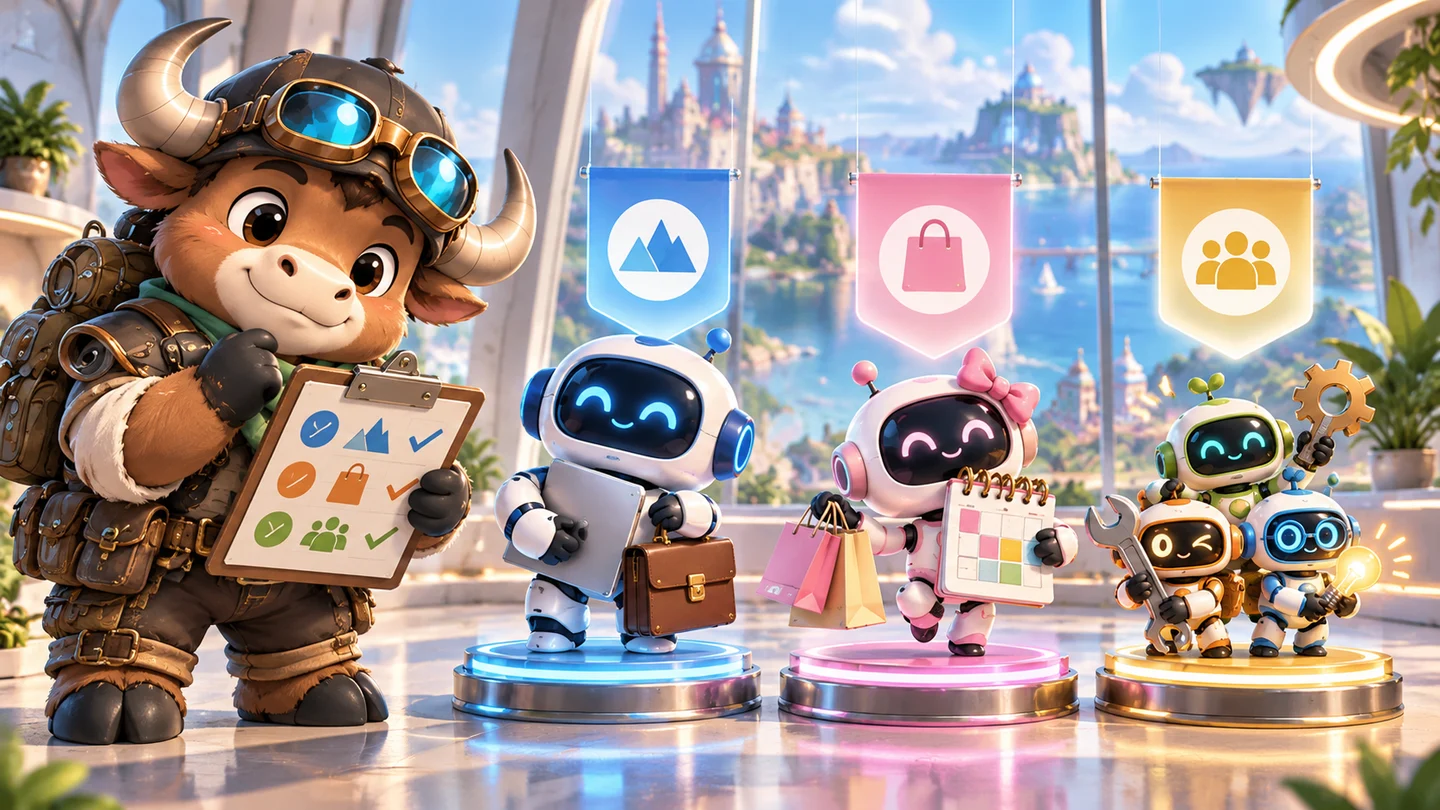
The key difference is the plural: users can create many Bots for different roles — say a Marketing Bot for campaigns, a Sales Bot for prospects, an Engineering Bot for bugs, an Operations Bot for office work.
xAI says Grok Bot began as an internal prototype used by its teams for sales outreach, marketing campaigns, office operations and bug fixes before going public. That’s why Grok Bot feels more like “building an AI team” than “having an AI assistant”.
Where are the three products alike?
Strip away the company logos and they share a lot. All three aim for agents that can run in the cloud, have their own browser/computer, use apps, remember context, do multi-step tasks and keep working when the user is no longer at the screen.
That’s the big shift: the AI race is moving from “which AI answers better?” to “which AI can be trusted to actually get work done?”.
But they differ in the “job to be done”
This is the most important part. OpenAI Dots can be pictured as a persistent work colleague — best when the work already lives in ChatGPT + Codex + connected apps. OpenAI is rolling Dots out gradually to some eligible Pro and Business Premium users.
Meta Muse is closer to a personal life agent — handling schedules, shopping, booking, household admin and personal goals; Meta is also extending Muse to small business and AI glasses. Grok Bot is closer to a team of AI workers — instead of one central agent, users create several specialized Bots and hand them different parts of the work.
At a glance: three directions
- OpenAI Dots — philosophy: persistent work; “home”: ChatGPT; own computer, runs in background; emphasis: context + work ecosystem; strong suit: long-running work.
- Meta Muse — philosophy: personal agent; “home”: Muse app / WhatsApp; own computer, runs in background; emphasis: personal life; strong suit: everyday tasks.
- Grok Bot — philosophy: AI teammates; “home”: Grok Bot; own computer, runs in background; emphasis: many bots; strong suit: splitting work across an agent team.
This summary describes product direction and what the companies are shipping, not a quality ranking. There’s no independent benchmark strong enough yet to say which one does delegated work best.
Pricing also shows who each company is aiming at
Entry points differ a lot right now: Muse has a free tier; Grok Bot can be accessed through eligible SuperGrok or Cursor plans; Dots is tied to eligible ChatGPT plans, with the initial consumer rollout focused on Pro.
This matches the positioning: Meta wants many people to try a personal agent, xAI wants developers/teams to try an AI teammate, and OpenAI places Dots near power users and professional workflows. But all three are very new, so pricing, quota and eligibility may keep changing.
Slack is the most interesting example of the difference
All three touched Slack at roughly the same time — but in three different ways. For Dots, Slack is a place you talk to the agent. For Muse, Slack acts as a connector the agent can use. For Grok Team Bots, a Bot can become a member in a channel.
Same app, three completely different readings — Dots: “talk to the agent”; Muse: “a tool for the agent”; Grok Bot: “where the agent sits and works”. This detail says a lot about each product’s philosophy.
Privacy and the right to act will be the next competition
An always-on agent differs from a chatbot in one crucial way: it doesn’t just know your data — it can be allowed to act on it.
Meta says Muse asks users to review and approve important actions like sending email or making a purchase, and provides an audit trail; credentials are kept in a secure credential store the agent doesn’t read directly. OpenAI also lets users define what the agent is allowed to do, connect the needed apps and bring results back for review.
When an agent can read email, access Drive, use a browser, send messages or buy things, the big question is no longer just “is it smart?” but also “how far is it allowed to go before it has to ask me?”.
This may be the real “agent war”
The model war of recent years focused on benchmarks, context windows, reasoning and coding. Always-on agents add a new battlefield: context + permission + tools + trust + distribution.
A smarter model doesn’t necessarily make a better agent if that agent can’t connect to the apps you use, has no work context, or keeps asking at every step. Conversely, an agent that sits right inside the ecosystem a user already lives in can have a huge advantage. That’s why Dots, Muse and Grok Bot look alike today but aren’t really three of the same thing.
Frequently asked questions
- What is OpenAI Dots? — Always-on agents in ChatGPT, running on GPT-6 Astra, with a cloud computer/browser, able to keep handling ongoing work.
- What is Meta Muse? — Meta’s personal AI agent, running on a persistent secure VM, able to browse the web, book, shop, fill forms and work through connected apps; it also works via WhatsApp.
- What is Grok Bot? — xAI’s AI teammates system; each Bot has its own computer, and many Bots can be used for different roles.
- The easiest difference to remember? — Dots lean toward work, Muse toward life, Grok Bot toward an agent team. That’s a summary of positioning, not a verdict on which is better.
- Has any product won yet? — There’s no basis to say so; all three are new and there’s no independent benchmark strong enough for real-world delegated work.