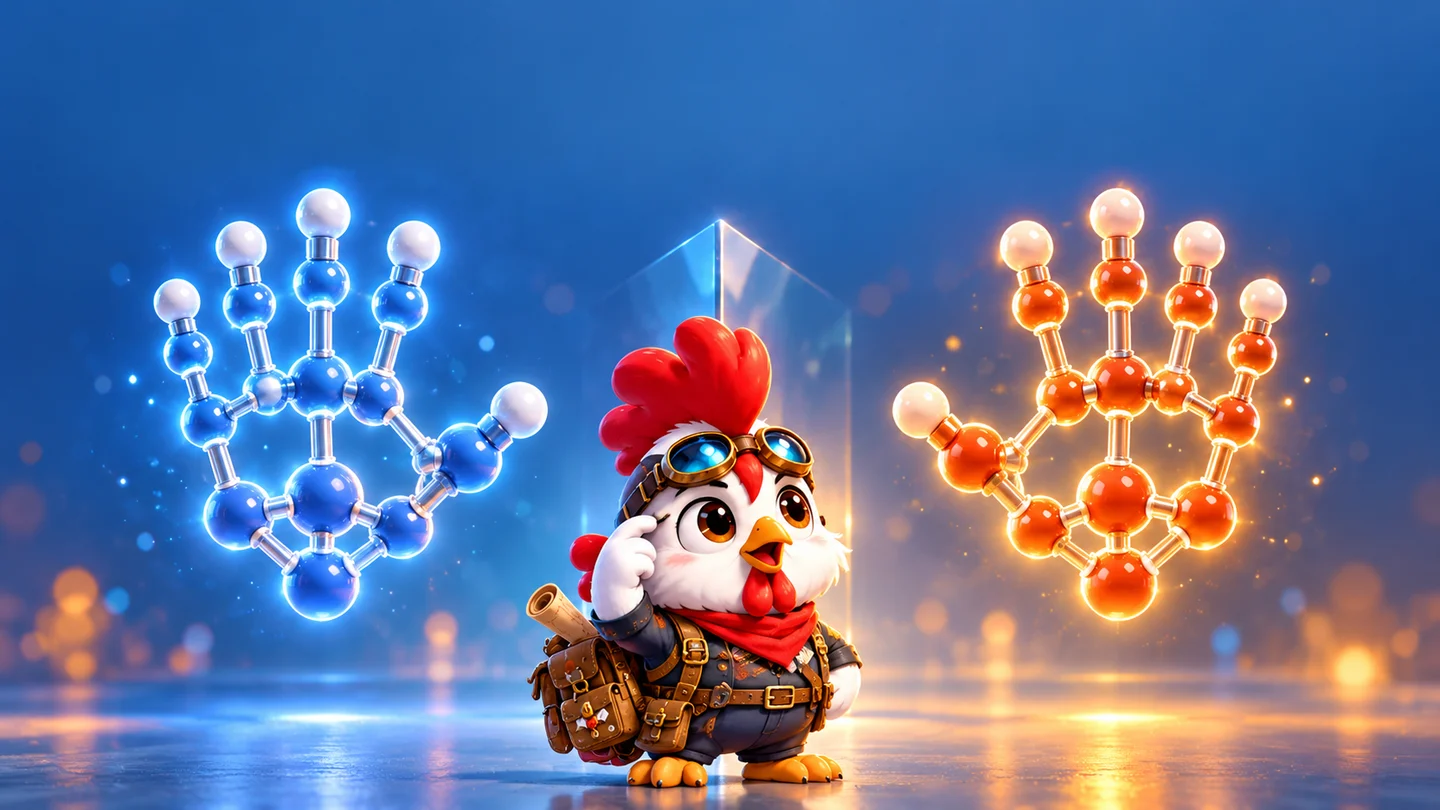
On 7 October 2026, the Royal Swedish Academy of Sciences announced that the 2026 Nobel Prize in Chemistry goes to Henri B. Kagan (France) and Kenso Soai (Japan), for their discoveries of non-linear effects and autocatalysis in asymmetric organic synthesis — work that helps answer a chemical mystery more than a century old. The prize of 12 million Swedish kronor is shared equally.
Why do molecules have a "left hand" and a "right hand"?
Look at your two hands. The left and right hands are built the same and are mirror images of each other; yet no matter how you turn them, they never fully overlap. Many molecules behave the same way: the same atoms and bonds, but a spatial structure that exists in two mirror-image forms. This property is called chirality.
Strikingly, living things usually favour one form. For example, the proteins in our cells are built mainly from L-form amino acids. Why did nature make this choice instead of using both forms equally? That question has occupied scientists for generations.
What did Henri Kagan and Kenso Soai discover?
The two scientists approached the problem from different, complementary angles. Henri B. Kagan studied reactions using asymmetric catalysts and found that a small difference between the two mirror forms of a catalyst can produce a far larger difference in the product — a phenomenon called a non-linear effect. In short, a reaction does not always directly mirror the starting ratio of its ingredients.
Kenso Soai showed that in some reactions the product can act as a catalyst to make more of itself — a process called autocatalysis. A tiny initial excess of one mirror form can be amplified over many cycles until one form becomes overwhelmingly dominant. This is known as the Soai reaction.
Why does this matter for pharmaceuticals?
Imagine a drug with two molecular forms as alike as two hands. Though chemically identical, they can interact differently with the body's biological structures: one form may have the desired therapeutic effect while the other is less effective or causes unwanted effects. Chemists therefore need methods to steer reactions toward the right form.
This year's Nobel-winning work provides scientific foundations for asymmetric synthesis, with special importance for pharmaceutical research and manufacturing. It does not mean the two scientists just invented a new drug — the prize recognises fundamental chemical discoveries with lasting applications.
A step toward understanding the origin of life
The significance of the 2026 chemistry prize goes beyond medicine. Kagan and Soai's work also helps address a bigger question: how could life develop a preference for one molecular form? A very small initial difference can be amplified into a large one — a mechanism offering important clues for studying homochirality, the uniform handedness of biological molecules. Still, these discoveries are not a complete answer to life's origin; they show chemical mechanisms that can create and amplify a preference for one form.
A prize for timeless discoveries
When told he had won, Kenso Soai, 76, was out shopping; he expressed joy at sharing the prize with Henri Kagan, the 95-year-old French scientist. The story reflects a trait of basic science: some research takes decades for its value to be fully recognised.
Conclusion: a small difference can have a big impact
The 2026 Nobel Prize in Chemistry honours two scientists who helped explain how chemical reactions select and amplify one of two mirror-image forms. From molecular structure to drug manufacturing, the discovery shows that seemingly tiny differences can lead to vastly important results. Sometimes, to understand life better, science must begin with a simple question: why are two things as alike as mirror images not exactly the same?
Frequently asked questions
- Who won the 2026 Nobel Prize in Chemistry? — Henri B. Kagan (France) and Kenso Soai (Japan), announced 7 Oct 2026.
- For what work? — Non-linear effects and autocatalysis in asymmetric organic synthesis.
- What is chirality? — When a molecule exists in two mirror-image forms that cannot be superimposed (like a left and right hand).
- What is it used for? — It underpins asymmetric synthesis, helping make drugs, flavours and materials with the desired molecular form.