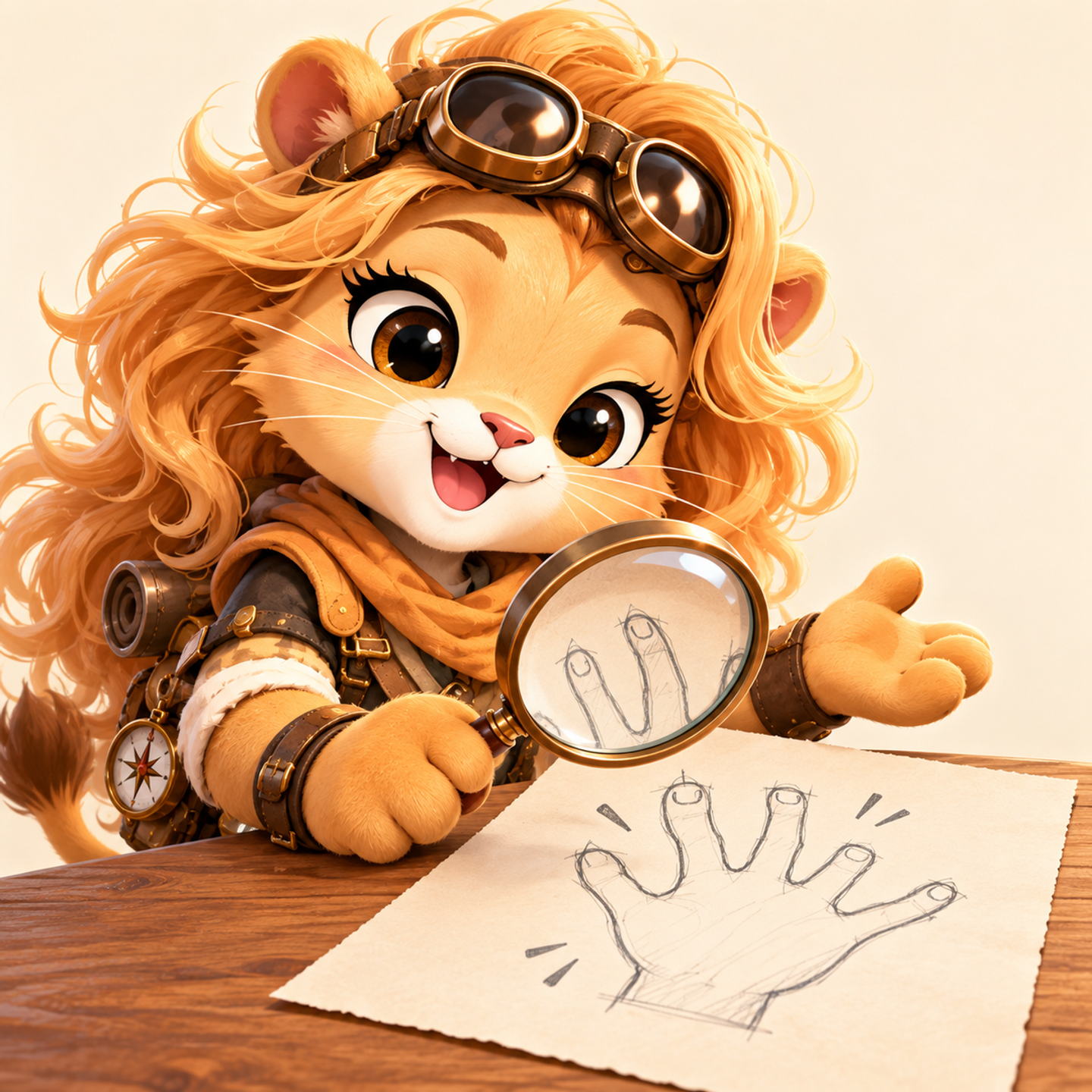
Human hands are what image models get wrong most, and the reason isn't that hands are 'hard to draw' in an aesthetic sense.
Where the model learns shapes from
A model learns from countless images, each a flat view of a three-dimensional object. With faces, the parts are almost always in the same relative positions: two eyes level, nose in the middle, mouth below. With hands, not so: the same hand can grip, spread, hide itself, or show only part of itself.
- The number of visible fingers changes with the camera angle, so 'a hand has five fingers' isn't a rule every image teaches.
- Fingers constantly overlap each other, and the hidden part isn't in the data to learn from.
- Hands are usually small in the frame, so their detail gets far fewer pixels than a face.
Why the error is so easy to spot
Viewers don't count fingers, but notice immediately when the number is wrong — the same mechanism that lets us see a face is off without pinpointing where. A tree with a few wrong branches goes unnoticed; a hand with one extra finger, everyone sees.
The model doesn't get it wrong because hands are hard. It gets it wrong because a hand rarely looks like itself twice.
Ghi chú biên tập